Case Study
StartupKroo Media Platform
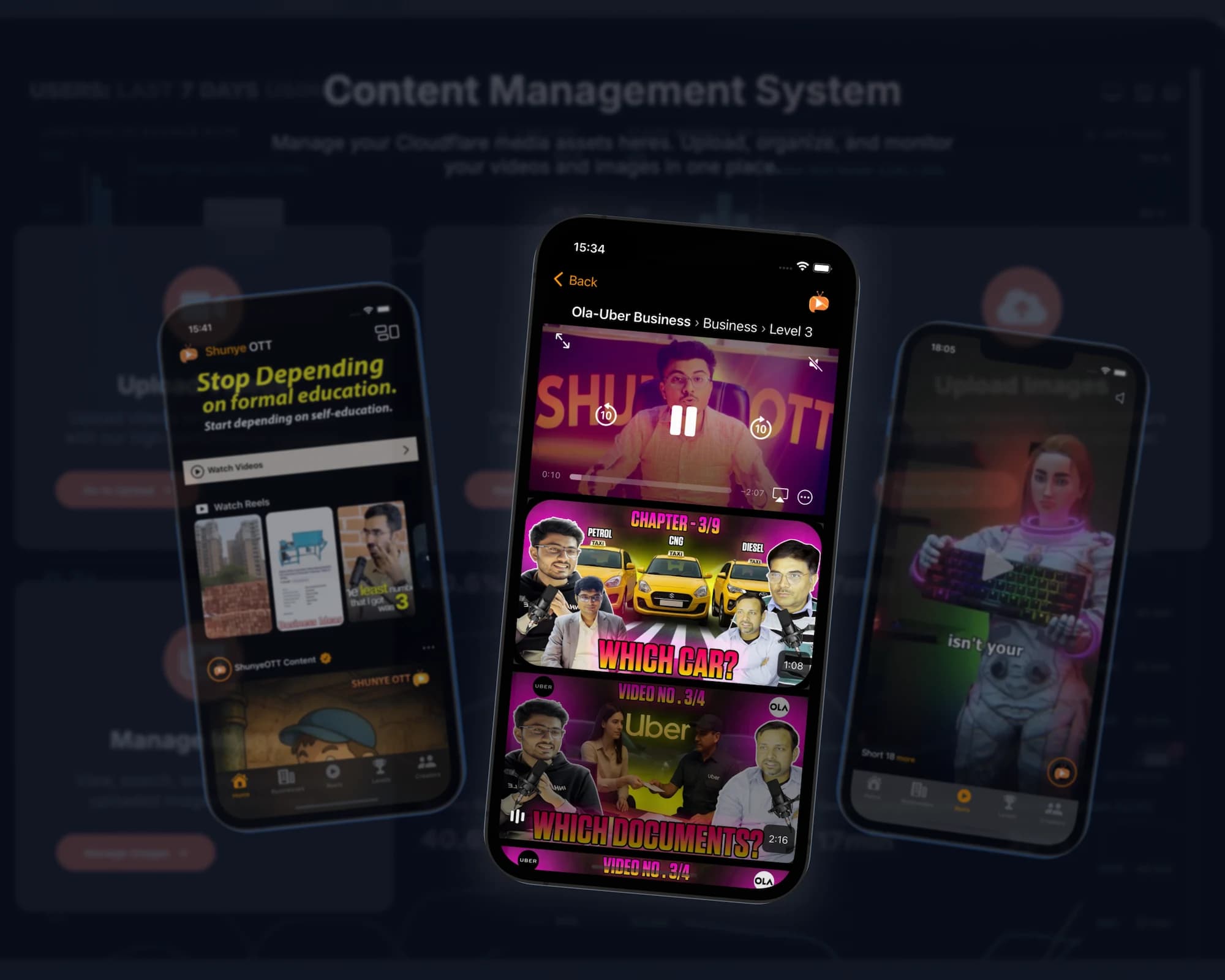
I led StartupKroo from early MVP experiments to a production video platform across Android, iOS, backend systems, and content operations — acting as the primary engineering owner shaping architecture, delivery, and technical direction.
Role
Primary technical owner across mobile, backend systems, CMS, and platform-level decisions — operating as lead engineer and an unofficial CTO-level partner.
Scope
Built and evolved the system from zero across Android, iOS, CMS, media delivery, schema design, deployments, and real-world production usage.
Focus
System architecture, product-aligned engineering decisions, scalability, and building a platform that could evolve without constant rewrites.
Context
Product context and system evolution
StartupKroo began as Shunye OTT — a video-on-demand platform centered around structured learning through levels. The early system focused on spiritual content produced in-house and delivered through a sequential learning experience.
Over time, the product shifted toward business learning. The platform evolved to include practical learning content across industries like ride-hailing, services, and small businesses. This shift eventually led to a full rebrand.
I joined from day zero and built the entire technical foundation. As the product evolved, so did my role — from development to architecture, decision-making, platform ownership, and working directly with the founder on product direction and feasibility.
Challenges
Platform constraints and realities
The product evolved significantly over time, requiring architecture that could adapt without constant rewrites.
Multiple surfaces — levels, feed, reels, creators — had to remain consistent across platforms.
Content operations required a fully usable CMS instead of engineering-dependent workflows.
Video infrastructure needed to balance cost, scalability, and production readiness under a single-engineer setup.
iOS deployment required solving App Store rejections and aligning the product with review expectations.
Decisions
Key engineering decisions
The key technical calls and trade-offs that shaped the platform.
YouTube for early MVP
Used YouTube integration in early phases to move fast and validate the learning model before committing to custom video infrastructure.
Cloudflare over Vimeo and Mux
Selected Cloudflare as the best balance between cost, scalability, and operational simplicity for a single-engineer setup.
Firebase backend
Chose Firebase to enable rapid iteration and reduce backend overhead, allowing focus on product delivery.
Firestore schema redesign
Moved from nested collections to flat relational structure to improve scalability, querying flexibility, and maintainability.
Hybrid iOS architecture
Used SwiftUI for general modules but switched to UIKit for feed and reels to gain performance and memory control.
Native over Flutter for video-heavy system
Evaluated Flutter, but playback performance and media control were limiting. Continued with native Android and iOS for full system control.
Approach
Architecture and platform direction
System-first thinking
Treated mobile apps, backend, and CMS as one system instead of separate builds.
Architecture driven by product evolution
Adapted system design as the product shifted from spiritual learning to business-focused content.
Operational systems as core product
Built CMS and workflows as part of the platform to support real content operations.
Key Implementations
Systems I built and owned
Android app
Built and evolved Android app across all product phases including learning, feed, reels, and playback systems.
iOS app
Developed iOS app and handled App Store approvals, architecture decisions, and production readiness.
CMS system
Built custom CMS and backend workflows for managing content, creators, and media.
Video infrastructure
Integrated Cloudflare-based video delivery with secure access and scalable distribution.
Outcome
Impact and delivery
Built a full production platform from zero.
Handled ~2K videos across multiple content surfaces.
Enabled real content operations through CMS.
Delivered stable apps used by real users.
Established long-term technical ownership of the platform.
Tech Stack
Tools and technologies
More Work